Preventing neurodevelopmental disease before it takes hold

We find the mechanisms that derail the developing brain, and build therapies that can be delivered early enough to prevent disease rather than treat its consequences. That means working while the brain is still forming — in the fetus, in the newborn, before dysfunctional networks consolidate.

Newborn excitatory neurons (green) climb radial glia from the ventricular zone to the cortical plate, deepest layers first. Inhibitory interneurons (red) arrive separately, migrating tangentially from the ganglionic eminence, a deeper structure.

Research

Three projects, one question: can we restore appropriate brain development before pathologic networks form?

STRADA, neuronal migration and epilepsy

Loss of STRADA causes PMSE, or Pretzel Syndrome, a severe childhood epilepsy. We are separating what STRADA loss does through mTOR from what it does independently of it, and asking what a cortex becomes when its inhibitory interneurons never arrive.

More

STRADA is an upstream inhibitor of mTORC1, and rapamycin acts on that arm. How much of the phenotype runs through mTOR, and how much through mTOR-independent roles of STRADA inside the migrating neuron itself, is the question we are working on: the two predict different windows for treatment and different drugs. We follow excitatory and inhibitory populations separately after in utero CRISPR knockout, because losing interneurons takes inhibition out of a cortex that is already miswired, and that shortfall is what a seizure-generating network is built on.

Patient-derived iPSCs let us ask the same question in human cells. We generate STRADA-deficient neurons from them and follow the mechanism of migration down to the patterns of cytoskeletal arrangement that move a cell along its track.

PMSE stands for polyhydramnios, megalencephaly and symptomatic epilepsy. It is most common in the Old Order Mennonite population and causes drug-resistant infantile seizures and cognitive impairment. We work with PMSE families and clinicians at the Clinic for Special Children in Lancaster County, Pennsylvania.
Low-intensity focused ultrasound to interrupt epileptic networks

After a neurological insult there is a latent period before the first spontaneous seizure. We are asking how excitatory–inhibitory balance is disrupted during that window, and whether non-invasive, low-intensity focused ultrasound can correct it before an epileptic network forms at all.

More

We study how an epileptogenic region reorganizes after a neurological insult, pairing histological analysis with electrophysiological recording to follow the shift in excitatory–inhibitory balance as it happens. Low-intensity focused ultrasound is our way of acting on that balance non-invasively and repeatedly, while the network is still being built rather than after it is finished.

If prevention works here, it should extend to other epilepsies that follow a known insult.

Fetal gene delivery for neurodevelopmental disorders

Severe neurodevelopmental disorders can now be diagnosed before birth. We are developing safe ways to deliver genetic therapy to the fetus, while the brain is still wiring itself.

More

Our long-term goal is to prevent abnormal networks from forming in monogenic disorders rather than treating their consequences. More to share soon.

Cool images: Science at work

This is what nanoparticles in a mouse placenta look like.
Making inhibitory neurons from human iPSCs
Guess which mouse fetus was treated for nanoparticle-nucleic acid delivery.
Recording in a mouse epilepsy monitoring unit

Strategies

The methods we use, from a single gene up to the whole brain. Choose one to see what it does for us.

nmMolecule

µmCell

mmCircuit

cmWhole brain

Focused ultrasound

Sound waves converge on a chosen region through the intact skull, with no incision and no implanted hardware.

Lab Members

Addie PWAddie PWScientist-In-Training

Lab alumni

Marianna Baybis, MSProgram ManagerRetired, living her best life
Asmaa HijaziResearch TechnicianPhD Student, Cornell University
Reana Young-MorrisonResearch TechnicianFuture MD/PhD Student
Sophie TranMedical Student VolunteerMedical Student, University of Maryland
Ally MackeyUndergraduate Summer StudentUndergraduate, University of Rochester
Justin DavisUndergraduate Summer StudentUndergraduate Student, Columbia University

Collaborators

Tina Wang, MA, CMINeuro Visualization and Communications
Peter Crino, MD, PhDNeurology Chair, mTOR wizard
Louis Dang, MD, PhDUniversity of Michigan
Jennifer Cohen, MDDuke University
Pavlos Anastasiadis, PhDFocused ultrasound engineering
Joseph Cheer, PhDProfessor of Neurobiology
Allison Lankford, MDObstetrics & Maternal-Fetal Medicine

Mascots

Boop one to evoke a response.

Big Mama

Whitney's cat

Minnie Mog

Addie's cat

Scuff

Danya's pup

Bailey

Alexis's cat

Jacky

Alexis's cat

Tux

Meghna's pup

Joey

Annie's pup

Burr

Vu's pup

Lab Updates

  • Upcoming

    The lab is presenting our work on STRADA (Ria Parikh) and focused ultrasound for epilepsy (Meghna Pandey and Dr. Parker) at the AES conference in Denver, CO.

  • Paper

    Our paper on STRADA deficiency and cortical interneuron development was published in Neurobiology of Disease, with Ria Parikh as first author.

    Read more

  • Paper

    Vu Nguyen's first-author case report on skull infarction and chronic subdural exudates in sickle cell anemia was published in Journal of Neurosurgery: Case Lessons, with several of our residents as co-authors.

    Read more

  • Award

    Danya Adams received a President's Entrepreneurial Fellowship.

  • Recognition

    Dr. Parker was named a Baltimore Magazine Top Doctor in Pediatric Neurosurgery for 2026.

  • Award

    Dr. Parker received an AES Young Investigator Award.

  • Award

    Ria Parikh received an AES Predoctoral Fellowship.

  • Award

    Meghna Pandey received an AES BRIDGE grant.

  • Talk

    Dr. Parker gave Grand Rounds at UC Davis Neurosurgery.

  • Award

    Danya Adams received a T32 Membrane Biology training grant.

  • Conference

    The lab presented our work on STRADA (Ria Parikh), and Dr. Parker spoke on fetal therapies for megalencephaly, at the AES conference in Atlanta, GA.

  • Award

    Dr. Parker received a UMSOM Mentor Recognition Award for Transformational Impact.

  • Recognition

    Dr. Parker was named a Baltimore Magazine Top Doctor in Pediatric Neurosurgery for 2025.

  • Talk

    Dr. Parker spoke about the lab's STRADA research at the iFeTIS Conference in San Francisco.

  • Funding

    Dr. Parker received an NIH/NINDS K08 career development award.

  • Funding

    Dr. Parker received an MSCRF Launch Award.

  • Conference

    The lab presented our focused ultrasound work at the American Epilepsy Society Annual Meeting, where Sandesh Kamdi was awarded a Grass Foundation Young Investigator Award.

    Read more

  • Award

    Sandesh Kamdi presented at the Baltimore Brain Series at Johns Hopkins and received an award.

  • Conference

    The lab presented our work on STRADA (Vu Nguyen) and focused ultrasound (Sandesh Kamdi) at the AES conference in Orlando, FL.

  • Award

    Dr. Parker received the Dr. Laure Aurelian Biomedical Research Award.

  • Team

    Vu Nguyen joined the lab as its first hire.

  • Award

    Dr. Parker received a Passano Foundation Clinician-Investigator Award.

  • Lab

    The Parker Lab opened at the University of Maryland, on the 9th floor of Health Sciences Facility III.

Key Publications

Dang LT, Glanowska KM, Iffland PH II, Barnes AE, Baybis M, Liu Y, Patino G, Vaid S, Streicher AM, Parker WE, Kim S, Moon UY, Henry FE, Murphy GG, Sutton M, Parent JM, Crino PB. Multimodal analysis of STRADA function in brain development. Front Cell Neurosci. 2020 May 8;14:122. doi: 10.3389/fncel.2020.00122.

Recent Clinical Publications

Search all on PubMed

Fun

Together outside the lab

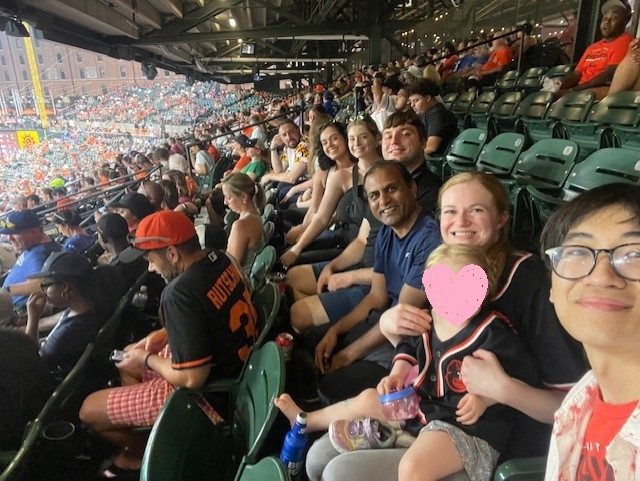
Parker Lab at the Orioles game
Parker Lab at the Orioles gameLet's go Os!
Lab dinner
Lab dinner
Lab lunch
Lab lunch
Lab dinner
Lab dinner
Lab trip to PA for PMSE Family Day

Opportunities

We are looking for motivated scientists who care about promoting healthy brain development and preventing epilepsy to join our lab family.

Graduate students

Join a project and train across molecular, cellular and systems neuroscience.

Undergraduate students

Learn to work at the bench alongside the whole lab team.

Lab technicians

Help run the experiments that keep our research moving.

Send a short paragraph about yourself and your CV or resume.
Whitney E. Parker, MD, PhD · Principal Investigator

wparker[at]som.umaryland.edu